
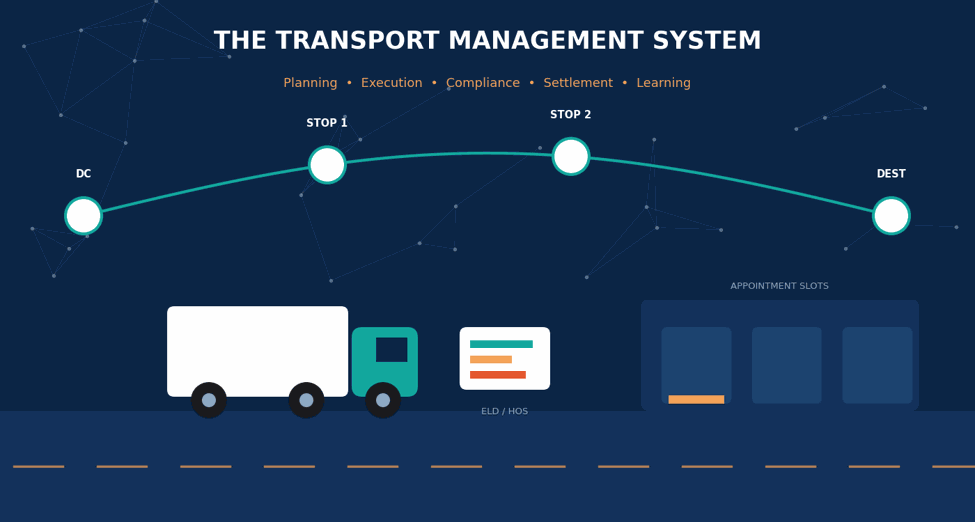
What changed
For most of its history, a transport management system did three jobs: build loads, pick a carrier, and produce the documents. Everything else happened on phones and in spreadsheets. Tracking was a call to the driver. Detention was an argument at invoice time. Compliance was a separate department with a separate system.
Three things broke that model. Telematics and electronic logging devices made the truck a continuous data source. Customers started expecting delivery visibility as a default rather than a premium service. And margins compressed to the point where unmeasured cost, which is mostly detention, empty miles and rework, stopped being survivable.
Industry 5.0 is a useful label for where this lands. Industry 4.0 connected the assets. Industry 5.0 asks what the connected system should do for the people in it: the planner who gets a workable plan instead of a puzzle, the driver whose day is not wrecked by a dock that runs three hours late, the carrier rep who negotiates with data rather than anecdotes.
What a modern TMS actually does
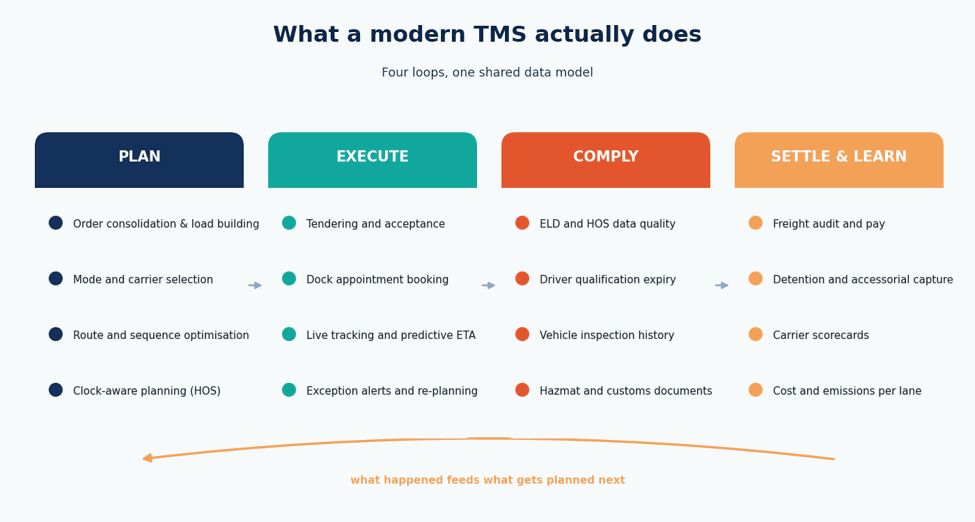
Plan
Order consolidation and load building, mode and carrier selection, route and stop sequencing. The meaningful upgrade here is clock-aware planning: building the plan against the driver’s remaining hours and realistic dock turn times, not just distance and a posted transit.
Execute
Tendering, acceptance, dock appointment booking, live tracking and predictive ETAs, and exception handling when reality diverges. The test of a good execution layer is not that it shows you a problem. It is that it re-plans around one and tells the people affected before they ask.
Comply
This is the part most TMS conversations skip, and it is where the measurable money sits. Hours-of-service data quality, driver qualification expiry, vehicle inspection history, hazmat and customs documentation.
Settle and learn
Freight audit and pay, detention and accessorial capture, carrier scorecards, cost and emissions per lane. Without this loop, every planning decision next quarter is made on the same assumptions as last quarter, whether or not they held.
Why compliance belongs in the TMS, with evidence
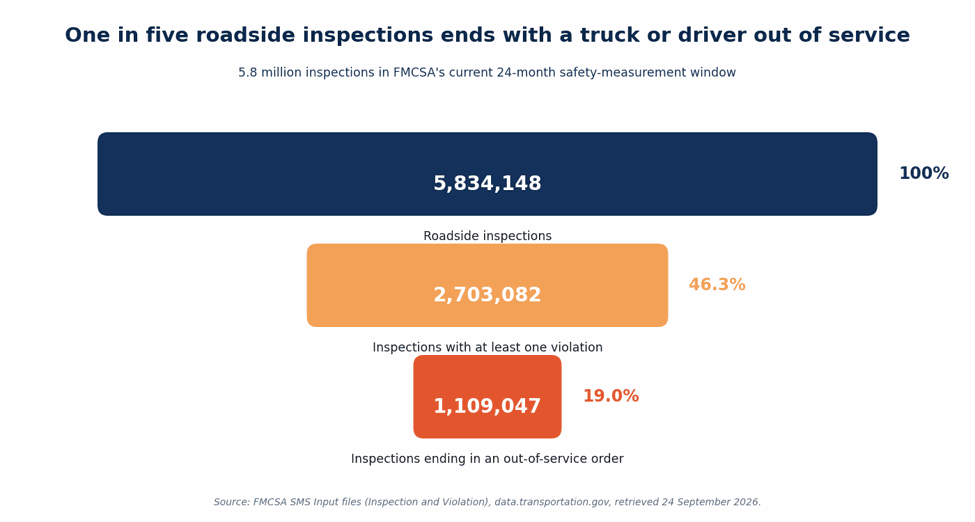
It is easy to treat compliance as somebody else’s system. The public enforcement record argues otherwise. In FMCSA’s current 24-month safety measurement window there were 5,834,148 roadside inspections, and 1,109,047 of them, 19%, ended with an out-of-service order.
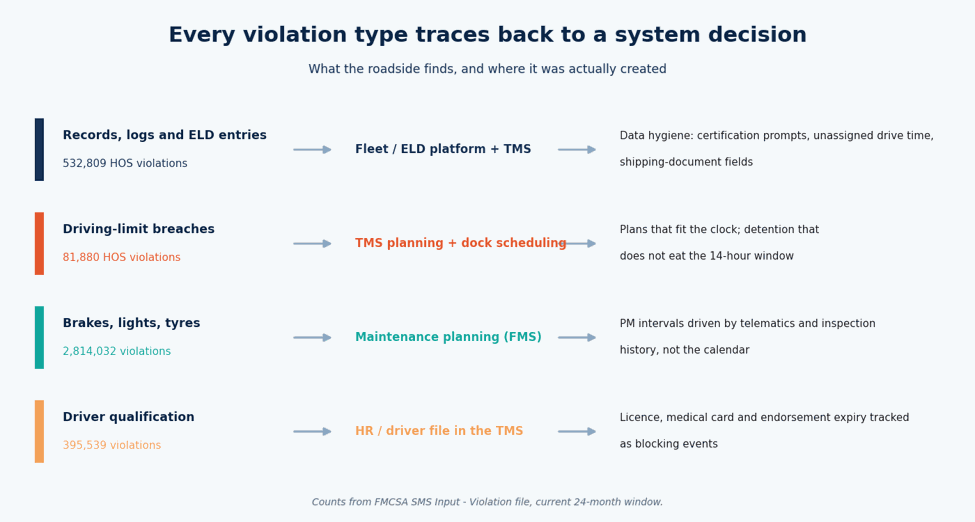
More usefully, of the 614,689 hours-of-service violations in that window, only 13.3% are actual driving-limit breaches. The other 86.7% are records: missing or non-compliant logs, ELD form and manner, drivers not certifying their own records, shipping document numbers not entered.
Most hours-of-service enforcement is catching bad data, not tired drivers. Bad data is a systems problem, and the system is usually the TMS and the ELD platform failing to talk properly.
Vehicle condition tells a similar story. Vehicle maintenance is 74.8% of all violations recorded, led by brakes, lighting and tyres, which are precisely the items a preventive-maintenance schedule and a driver vehicle inspection report already cover.
The labour constraint behind all of it
There is a second reason to care about the execution layer. Transport and warehousing churn is extreme. Summing the BLS JOLTS monthly rates for transportation, warehousing and utilities across the twelve months to July 2026, the sector hired 48.8% of its employment and separated 49.2%, with voluntary quits alone at 26.7%.
A system that depends on tribal knowledge, on the planner who knows which receiver always runs late and the dispatcher who remembers which driver hates that lane, is a system that loses half its institutional memory every year. Encoding that knowledge, in appointment reliability scores, in site-level dwell times, in lane-level carrier performance, is not a nice-to-have in a workforce that turns over annually. It is the only way the knowledge survives.
Six decisions that shape the outcome
1. Integration depth over feature count
A TMS that cannot exchange appointment times with the WMS and duty status with the ELD platform will produce plans that break at the dock. Evaluate the integrations first and the feature list second.
2. Who owns the data
Telematics, ELD, appointment and tracking data all describe your operation. Establish, in the contract, who owns it, whether the vendor can use it to train shared models, and how you get it back in a usable form if you leave.
3. Carrier and partner interoperability
Tendering, tracking and invoicing still run on a mix of EDI and APIs. The practical question is how quickly a new carrier can be onboarded to full visibility, because that number governs how freely you can shift volume.
4. Model drift and explainability
Predictive ETAs and dynamic pricing degrade as networks change. Ask how the model is retrained, how often, and whether a planner can see why a recommendation was made. An unexplainable recommendation will be ignored by the people who have to execute it.
5. Cybersecurity
A TMS holds customer addresses, rates, shipment contents and driver personal data, and increasingly holds the keys to systems that move vehicles. Treat it as core infrastructure, with the segmentation, access control and incident response that implies.
6. Human-centric design
The driver app and the planner screen are where adoption is decided. If certifying logs takes six taps, drivers will defer it, and deferred certification is one of the most common violations in the national record. Friction in the interface becomes a violation at the roadside.
A sequence that works
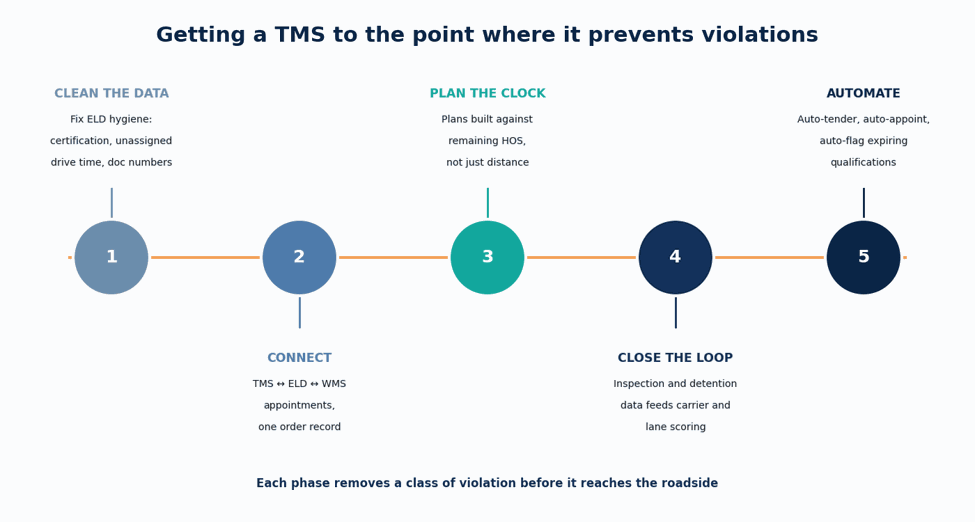
• Clean the data. Fix ELD hygiene first: certification, unassigned drive time, document numbers. It is the cheapest phase and it removes the single largest category of violations.
• Connect. One order record shared across TMS, ELD and WMS, including the appointment. Most execution failures are two systems holding different versions of the same time.
• Plan the clock. Move planning from distance-and-transit to remaining hours and realistic dwell.
• Close the loop. Feed inspection outcomes, detention and appointment reliability back into carrier and lane scoring.
• Automate. Auto-tender, auto-appoint, and block assignments on expiring qualifications. Automate last, once the data underneath is trustworthy.
What to measure
Three metrics separate a TMS that is genuinely working from one that is merely installed:
• Out-of-service events per 1,000 loads, by lane and by receiving site.
• Detention minutes preceding any driving-limit violation. If your drivers run out of clock at the same three receivers every month, that is a commercial conversation with evidence attached.
• Time from a driver vehicle inspection report flagging an item to the work order closing. This is the gap that turns into a brake or lighting violation at the scale house.
None of these require a new vendor. They require joining data the operation already generates, which is the whole argument for treating the TMS as the system of record for transport rather than as a booking tool.
Enforcement figures: FMCSA Safety Measurement System input files (datasets rbkj-cgst and 8mt8–2mdr), queried 24 September 2026. Labour figures: BLS JOLTS, transportation/warehousing/utilities, twelve months to July 2026, monthly rates summed.
This article was originally published on Medium by Ponvannan P.